
Bob Arum – From Lawyer to the Creator of the Top Rank Empire
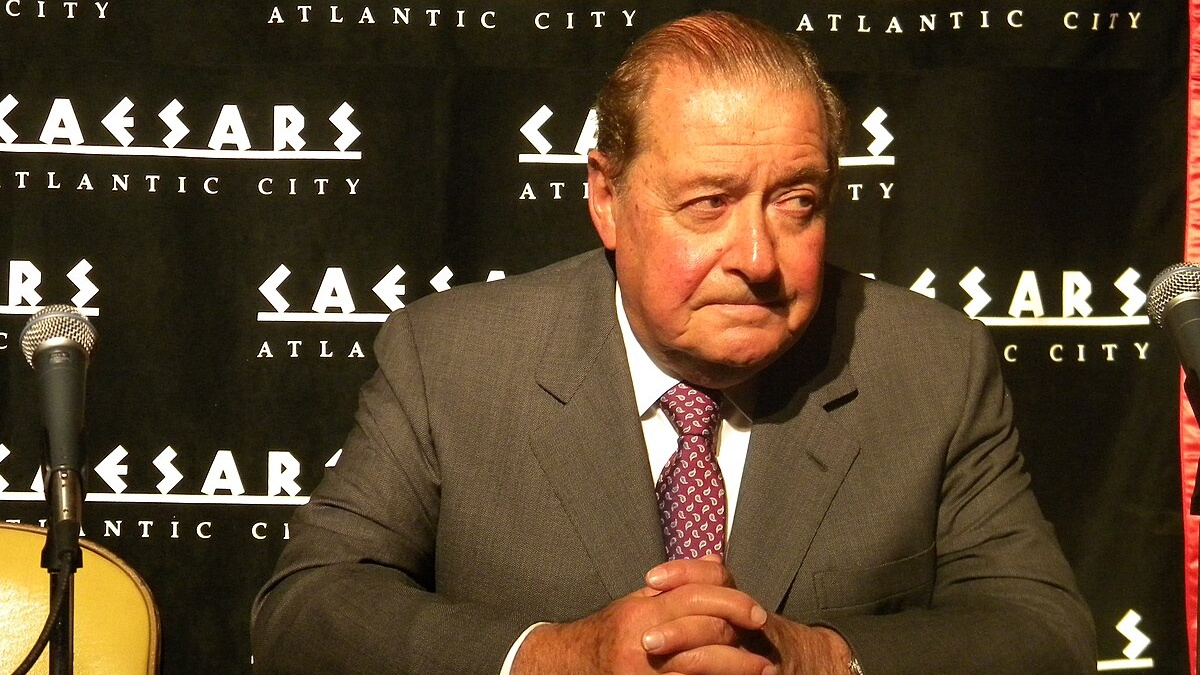
The prominence of Al Haymon, today the biggest star in the boxing business, attracts the attention of fans and journalists. That does not mean, however, that there are no other important figures in the sport. One of them is Bob Arum. As long as his age allows him to continue, he has no intention of yielding ground to Haymon or any other promoter dreaming of success.
Modern media rarely have time to present their subjects in greater depth. Long analyses have been replaced by brief comments, and sometimes by just 140 characters on Twitter. Arum, too, is often judged through the prism of the last few years and the results achieved by his fighters. Yet for nearly half a century he has remained at the center of the most important events and is one of the architects of modern boxing.
From Bellhop to Millionaire
Robert “Bob” Arum was born on December 8, 1931, in New York, into a family of Orthodox Jews. He grew up in Brooklyn’s Crown Heights, among synagogues and the Jewish middle class. He attended Erasmus Hall High School and, as a young man, earned extra money as a hotel bellhop.
He studied at New York University. In 1956, he graduated with honors from Harvard Law School. He worked as a tax expert on Wall Street, later in the New York prosecutor’s office, and then at the United States Department of Justice.
At the time, he had little interest in boxing. He had not even attended a boxing event, although he remembered radio broadcasts of Joe Louis’s fights. The case involving financial irregularities at the company of Roy Cohn, one of the promoters of the first Patterson–Liston fight, brought him closer to the sport. As a lawyer, Arum became interested in what he saw in the documents.
In 1966, he founded Main Bout together with, among others, Jabir Herbert Muhammad. Jabir was the son of Elijah Muhammad, the creator of the controversial Nation of Islam, and the manager of his most important client, Muhammad Ali. Initially, all attention was focused on “The Greatest,” then a reviled fighter who was unable to fight in the United States.
When organizing Ali’s fight with George Chuvalo in Toronto on March 29, 1966, Arum saw a live boxing match for the first time. He later admitted that he still could not tell the boxers apart and did not even know how many weight classes existed.
In 1973, Arum and Jabir incorporated Top Rank Inc. In the 1980s, the company began competing with Don King for supremacy in professional boxing. Its bold partnership with the then-fledgling ESPN helped make that possible. In 1980, the Top Rank Boxing on ESPN program debuted on the network.
Arum also quickly recognized the potential of Hispanic fighters. He organized their fights in the southwestern United States and worked with Spanish-language television networks. Among those he introduced to the world were Alexis Argüello, Roberto Durán, Juan Manuel Márquez, Paulie Ayala, Michael Carbajal, Carlos Monzón, Julio César Chávez, Oscar De La Hoya, Erik Morales, Miguel Cotto and Antonio Margarito.
Later, Top Rank turned to Asian talent, including Manny Pacquiao, Nonito Donaire, Zou Shiming and Ryota Murata. Arum’s stable also included Russians such as Denis Shafikov, Yegor Mekhontsev, Matt Korobov, Evgeny Gradovich and Khabib Allakhverdiev, as well as Ukrainian Vasyl Lomachenko. The promoter also worked with heavyweight champions such as Joe Frazier, Larry Holmes and George Foreman.
Over nearly half a century, Arum promoted more than 400 world championship fights. Top Rank organized more than 9,000 bouts and 1,500 cards in 22 countries across six continents. The company looked after dozens of fighters, and its owner was inducted into the International Boxing Hall of Fame. His wealth was estimated at around $200 million.
Plenty of Controversy
Arum’s story cannot be described solely through numbers. For four decades, he competed with King, who called him “Lonely Bob.” In 2000, Arum testified in a trial concerning King’s bribery of the IBF president. The matter involved securing a favorable ranking for one of his fighters.
There were other disputes as well. On October 22, 1994, a card titled “High Noon in Hong Kong” was scheduled to take place under the auspices of the WBO. The lineup included fights between Tommy Morrison and Herbie Hide, Steve Collins and Lonnie Beasley, Billy Schwer and Rafael Ruelas, as well as Frank Bruno and Ray Mercer.
At the last minute, Barry Hearn withdrew Hide and Collins because there was not enough money to pay their purses. Arum, the event’s nominal promoter, did not want to cover the estimated $2 million cost. His partner, John Daly, in turn claimed that he had financed the stadium, broadcast time and other expenses, but was not responsible for the fighters’ purses. Furious, Hearn and Mickey Duff, who represented Bruno and Schwer, threatened to sue.
A year later, the Nevada State Athletic Commission fined Arum $125,000 and banned him for six months from attending weigh-ins or entering dressing rooms and the ring in Nevada. The case concerned a $100,000 bribe paid to IBF founder Robert W. Lee in exchange for sanctioning the fight between George Foreman and Axel Schulz.
In 2004, while Arum was away, FBI agents searched Top Rank’s offices in Las Vegas. The investigation concerned, among other things, De La Hoya’s rematch with Shane Mosley, fights involving Eric Esch, and the bout between Jorge Páez and Verdell Smith. In 2006, the case was closed without result.
In 2007, Floyd Mayweather Jr. accused his former promoter of underpaying him, providing inadequate promotion and exploiting his talent. He claimed that he earned more in two fights after splitting with Arum than he had during 30 bouts under Arum’s guidance. He also accused him of manipulating officials and bribery in the case involving Erik Morales.
Criticism and Harsh Words
Arum had long been known for his sharp tongue. With age, his statements became even more cutting. In 2003, he claimed that De La Hoya’s loss to Mosley was revenge by a former member of the Nevada athletic commission. He later apologized for those remarks.
In 2007, UFC president Dana White said that greedy promoters such as Arum were sucking the life out of boxing. The conflict concerned the weak undercard before the De La Hoya–Mayweather Jr. fight. Arum responded by telling UFC fighters to look at the organization’s revenues and ask its leaders why they were not earning more.
A few years later, he called UFC fans skinheads and compared MMA fighters to people rolling around on the ground. In 2009, he defended Margarito, who had lost his California license following the illegal-hand-wrapping scandal. Arum suggested at the time that the suspension had racial motives.
The promoter also sued HBO, accusing the network of crossing the line and effectively taking on the role of a promoter. He claimed that the network’s policies had cost him Mayweather Jr. The dispute ended in a settlement, but Arum continued to criticize HBO and Showtime. He believed that since the 1990s, the networks had stopped cooperating with promoters, taking control of the best fighters and limiting access to their fights.
He also made headlines when he urged fans to boycott the Maidana–Mayweather fight. His aim was to bring about a Mayweather–Pacquiao bout. Mayweather’s supporters responded, however, that Arum himself bore the greatest responsibility for the fight never happening.
A Great Businessman
Regardless of how he is judged, Arum is regarded as an excellent businessman. He is praised for his organization, intelligence and ability to choose the right associates. If he does not understand something—for example, new media and technology—he finds someone who knows more about it.
That is why his stepson, Todd duBoef, who has been associated with Top Rank since 1993, became the company’s president. Todd is known for his energy and hard work. He is already regarded as one of the most important figures in boxing.
Arum’s empire does not depend on one fighter, one television network or one city. Top Rank survived even after Mayweather Jr. and De La Hoya left. Arum moves skillfully among promoters, sanctioning bodies and state commissions. Although he criticizes the UFC, he appreciates its marketing and openly admits that Top Rank uses similar methods.
Coolly and patiently, he builds stars, bringing out the best in their talent. This is particularly evident in the lighter weight classes. Arum thinks in terms of a several-year plan rather than just the next fight. He knows when a fighter is ready for the next step and which opponent should be selected.
That often means building a fighter’s standing against less significant opponents or boxers already past their prime. He stages major fights in different parts of the country, reaching a broad audience rather than only viewers willing to pay for pay-per-view. Over the years, he has built such a strong position in television that when he speaks of someone’s great talent, networks immediately take notice of that fighter.
Arum at Home
Arum has a son, a daughter, a stepson and a stepdaughter. His son John, an experienced mountaineer, died in September 2010 while climbing Storm King Mountain.
The promoter does not like sitting idle. He works a great deal, watches sports, plays tennis, swims and spends time with his grandchildren. He reads and takes an interest in politics and history. He is a Beatles fan, but cannot stand hip-hop or heavy metal. His favorite film is “Casablanca.” He enjoys the films of Mel Brooks and Woody Allen, and considers “Blazing Saddles” the funniest movie.
He has had dinners with Al Pacino, Christopher Walken and Samuel L. Jackson. When he is not watching sports, he chooses HBO series. After losing more than 13 kilograms, he eats whatever his body tolerates, but in small quantities. He does enjoy chocolate ice cream, however.
He considers Foreman’s knockout victory over Michael Moorer the greatest moment of his career. The most painful memory is the death of Duk Koo Kim after being knocked out by Ray Mancini.
He also remembers an event from April 1986. The day after being knocked out in the first round by Thomas Hearns, James Shuler came to Arum’s hotel room and thanked him for arranging the fight. A few days later, he died in a motorcycle accident. Arum later said that he was the only boxer who had ever thanked him for his work.
Grandfather to Us All
Arum’s long and successful career is sometimes overlooked today, particularly by young fans focused on current events. His language, controversial statements and conservative views can be irritating. It is difficult, however, not to appreciate an octogenarian who has not shut himself away at home, continues to work, can tell Facebook from a smartphone and has more energy than many of his grandchildren.
Bob Arum remains an ambiguous figure. His decisions and words can be criticized, but there is no disputing the place he occupies in the history of professional boxing.

A programmer by profession, he supports the development of the website by combining his technical expertise with a passion for sports. On a daily basis, he ensures the platform’s stability and develops new features to improve its functionality and overall performance. In addition to his technical work, he also creates content for the website and attends various sporting events.
Read more great content by this author!


