
Antoni Czortek – the boxer who fought for his life
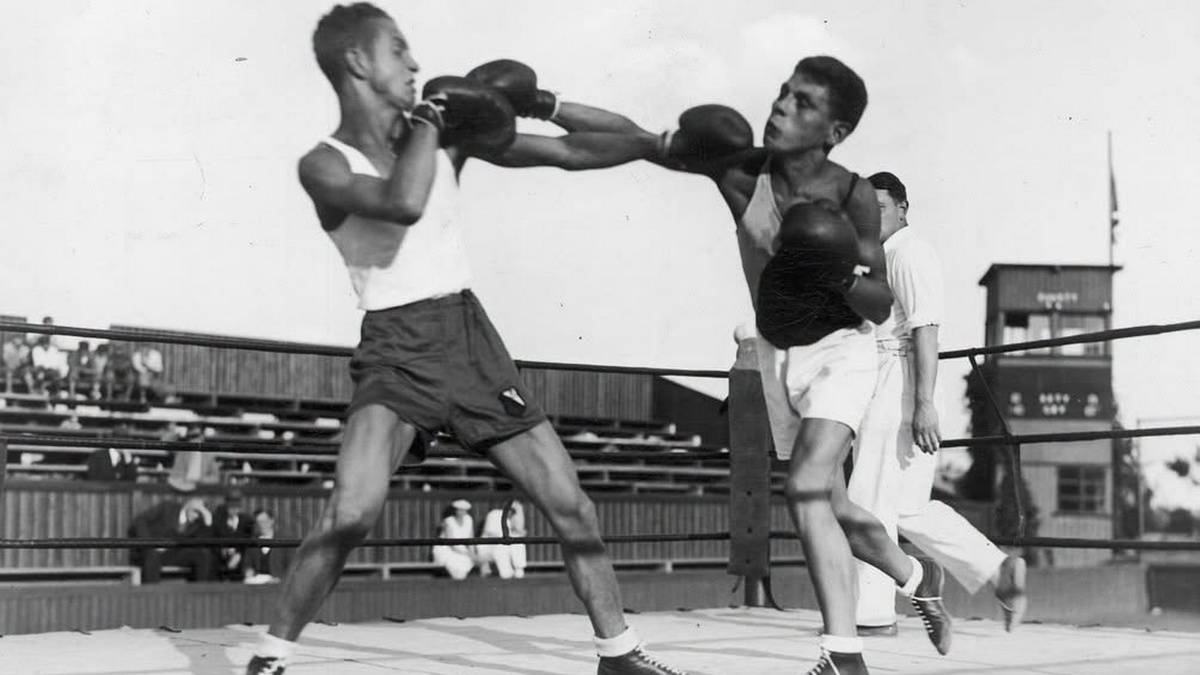
Antoni Czortek remains one of the greatest figures in the history of Polish boxing. He was an outstanding boxer and later also a coach and mentor to young athletes. Feliks Stamm said of him in 1963: "I consider Czortek the best featherweight in the history of our boxing". The honorary citizen of Radom, who died six years ago, competed at the Olympic Games in Berlin (1936), won a silver medal at the European Championships in Dublin (1939), and became Polish amateur champion four times. The popular "Kajtek" was also one of those Polish boxers whom the Germans forced into heroic fights for survival in the concentration camps of Auschwitz-Birkenau and Mauthausen-Gusen.
Czortek, prisoner number 139559, fought 15 bouts in Oświęcim against opponents much heavier than himself. The first and final fights were the most memorable, however. In his debut, "Kajtek" defeated one of his Spanish fellow prisoners. In his fifteenth bout, he faced an SS man named Walter. After the very first punch to the jaw, the German fell to the canvas. An incredible roar of support erupted around the ring. The prisoners’ joy carried the Pole to an even better performance. In the third round, Walter hit the canvas again, and the unanimous decision went to Czortek. His fellow prisoners then lifted him onto their shoulders and, singing Dąbrowski’s Mazurka, carried him back to the block.
One of Antoni Czortek’s last photographs
Czortek, born in 1915, initially wanted to become a track-and-field athlete. He began training in boxing at the age of 16 at "GKS Pomorze" Grudziądz, also known as PePeGe. He later represented Skoda Warszawa (1935–1936), Okęcie Warszawa (1936–1939), Orzeł Warszawa (1946), and Radomiak (1947–1949). He owed his nickname to his modest physical stature. He boxed from flyweight to lightweight.
He was an all-round boxer, and his style always provided the crowd with excitement. Poland’s sporting public first heard about Czortek’s talent in 1934. At the age of 19, he won his first Polish championship gold medal in Poznań, competing at bantamweight. In the final, he defeated, among others, national-team representative Szapsel Rotholc. He later stood atop the national championship podium three more times: in Łódź (1938, featherweight), Katowice (1939, featherweight), and Wrocław (1949, lightweight).
During his amateur career, he fought 328 bouts. His record was 269 wins, 43 losses, and 16 draws. Between 1934 and 1949, he represented Poland 23 times in international matches. He recorded 18 wins, one draw, and four defeats. In January 1939, he was named the best boxer of the Poland–Sweden match. As a reward, he received a special cup from Sweden’s King Gustav.
Czortek competed at the European Championships twice. In Milan (1937, bantamweight), he finished fourth. Two years later, in Dublin (1939, featherweight), he won a silver medal. After victories over Estonia’s Koebi and Belgium’s Genote, he unfairly lost the final to Ireland’s Dowdell. Following that success, he was selected for the European team for a match against the United States. The bout never took place, however, because war broke out.
Earlier, at the Olympic Games in Berlin (1936, bantamweight), he fought two bouts. He first defeated France’s Bonnet and then lost to Hannan of South Africa.
After World War II broke out, Czortek was mobilized and quickly sent to the front. His regiment was crushed near Wieluń. The boxer returned to Warsaw in civilian clothes, where he hid from the Nazis under the name Antoni Kamiński. He later went to the area around Grójec, to his wife’s family. There, a German patrol shot him in the leg. He limped for the rest of his life.
In 1943, he decided to return to the capital. Gendarmes arrested him at the railway station. They recognized him as a famous Polish boxing champion and sent him to the camp in Oświęcim. He was held there from August 24, 1943, until January 1945. In January, he was deported deeper into Germany, to the camp at Mauthausen-Gusen. There, too, he was forced to fight in the ring. He most often competed against his friend and fellow prisoner, Zygmunt "Munio" Małecki. He lived to see liberation on May 5, 1945.
The liberation of the Mauthausen-Gusen concentration camp
After the war, Antoni Czortek settled in Warsaw. He moved to Radom after unexpectedly losing a bout for the Polish championship in 1947 to a little-known boxer from Częstochowa.
"After that defeat, I was ashamed to return to Warsaw. Then an unexpected offer came from Radom. The head of Radomiak’s boxing section suggested that I move there. My wife, a native of Warsaw, cried bitterly. The local officials promised us a two-room apartment with a kitchen, and that decided it. In the end, they gave me only one room" – Czortek recalled in Zbigniew Puszka and Paweł Strus’s book "Radom’s Olympians".
That was how "Kajtek" became associated with Radom. As a Radomiak fighter, he won his last Polish championship title in 1949. After ending his career, he became a coach. He first worked at Radomiak and later at Lotniczy KS Czarni Radom and Broń Radom. Among those he trained was future Olympic champion Kazimierz Paździor.
In later years, Mr. Antoni became a taxi driver, but he never broke contact with the city’s sporting community. The Polish boxing community also remembered him. In 1988, the BOKS monthly honored him with the Alexander Reksza Award.


