
Moses Friedler: The Boxer Who Fought to Survive
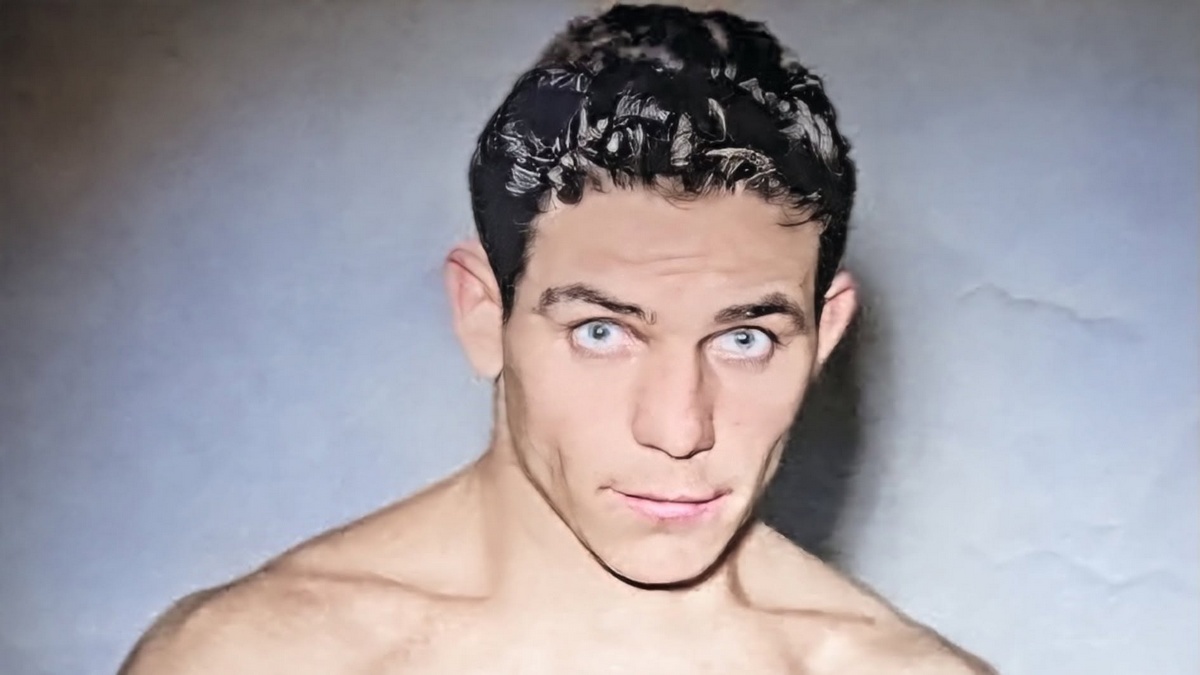
For just 24-year-old Hershel “Harry” Haft (14-8, 8 KOs), his third-round knockout loss to the not-yet-legendary American champion Rocky Marciano on July 18, 1949, was both the peak and the end of his sporting career. Haft fought just 22 professional bouts in total. Few people in America knew, however, that this boxer born in Bełchatów had fought as many as 75 times during the occupation. These were not ordinary boxing matches. His life was at stake. They were organized in the subcamp Arbeitslager “Neu-Dachs” No. 147 in Jaworzno, part of the Auschwitz-Birkenau concentration camp complex.
Moses Friedler—Haft’s real name—was born on July 28, 1925. He was the eighth child in a poor Jewish family from Bełchatów, then a small town located near industrial Łódź. In 1941, at the age of 16, he was deported to Auschwitz. After about two years, he was transferred to Jaworzno.
Harry’s eldest son, Allan Scott Haft, did not hear about his father’s traumatic experiences until 2003. In his book “Harry Haft: Survivor of Auschwitz, Challenger of Rocky Marciano”, published three years later by Syracuse University, he described, among other things, details of the camp fights.
The makeshift ring stood on a packed dirt road in front of the SS men’s quarters. It was marked out by four wooden beams driven into the ground. The fights took place every Sunday. During that time, the guards ate, drank alcohol, smoked cigars, talked loudly and enjoyed themselves, as if the lives of the fighting boxers meant nothing at all.
Most often, the men boxed without gloves. In a way, however, the official rules were observed. Blows below the belt, among other things, were forbidden. The referee held absolute power over the entire macabre spectacle. He decided which fouls would be tolerated. There was no limit on the number of rounds. The fight ended when one of the contestants fell unconscious or was no longer able to continue because of his injuries.
In most cases, the loser was murdered by the guards. That was what happened after Haft fought a Frenchman, a prewar heavyweight boxer. After the opponent had been carried away from the ring, Haft heard two rifle shots from behind one of the nearby barracks. The winner received an extra ration of food and another week of life. Until the following Sunday. Haft, who knocked out 75 opponents, received something else from the guards: a cursed fame and the nickname “The Jewish Beast.”
This is what the camp “promoters” of the boxing fights looked like
In April 1945, during the evacuation of the camp and the so-called death march, Harry and several fellow prisoners managed to slip away from the group unnoticed once they were already in Germany. Terrified, hungry and dressed in rags, they hid in the forest. Years later, Haft recalled that, in order to survive, they even had to kill civilians one day. They feared they would be turned in.
After the war, until 1948, Haft stayed in various displaced-persons camps in Germany. Eventually, he contacted an uncle living in New Jersey. A few months later, he reached America.
At that time, boxing was one of the most popular sports across the Atlantic. After all, the so-called Golden Era of American Boxing was underway in the late 1940s. It was no wonder that Harry, without a profession and with only a limited command of English, decided to make a living with his fists.
The 75 fights he had taken part in at the camp were not genuine boxing contests, however. Haft quickly realized this in the United States. The camp bouts had primarily taught him how to fight. He had neither style nor proper technique. He never managed to make up for those deficiencies. When the bell rang, he charged at his opponent furiously, intent on putting him on the canvas as quickly as possible.
He made his professional debut on August 6, 1948. He won by second-round knockout against Jimmy Letty. After twelve victories, he suffered his first defeat. The experienced Irishman Pat O’Connor proved the better man.
On March 28, 1949, in Miami, Florida, Haft fought an extremely exciting bout against Polish boxing icon Henryk Chmielewski. He lost by ninth-round TKO. Even though his record was looking increasingly poor, he continued to be invited to fight cards. His aggressive, almost frenzied style guaranteed a spectacle.
Among others, he lost to the undefeated Rolando La Starza, and later to Rocky Marciano as well. One prominent American sportswriter once wrote that having the great Marciano on one’s record was a source of pride, regardless of the result of the confrontation.
That is why Moses Friedler is worth remembering. He was a young man born almost in the very center of Poland who first fought for his life in a camp and later dared to step into the ring opposite a boxing legend.


